Tuesday, June 28, 2011

Poll no. 1: A Familiar Tree is Not Always Native!

About a month ago I discovered the poll option in my blog. I did not know before that you could actually create a section here where readers could vote on a certain topic. I was excited in choosing what would be the very first poll question I would air for blog followers and the topic was not at all hard to come up with.

Every time I do a lecture on trees I always start with species which I anticipate most of my listeners would be familiar with. Usually it would include acacia, mango, langka, santol, aratiles, macopa, duhat, atis, papaya, kaimito, chico etc., which are basically what we find growing in most Metro Manila households. All of them get a bit surprised that none of the mentioned are actually native to the Philippines. Most are either Central or South American species brought here in the Galleon trade routes. Some have also been prehistorically introduced by ancestral Filipinos when they rode their bancas (from mainland Asia, Indonesia or Polynesia) and settled on Philippine shores. These trees we find abundantly growing as echoes of what our ancestors have told us to grow in our households. In the case of the gallleon trade trees, they were subliminally forced upon us by the gobernadorcillos and prayles, telling indios what were productive to cultivate and domesticate. One example is the song bahay kubo where a lot of common vegetables were mentioned to be planted in our backyard, yet none of these are native. Because of it the Bicolano laing could never be complete without the sili (Capsicum, native to the Americas). Karekare and paella could never be as delectable and colorful without achuete (Bixa orellana, also from Americas) etc.

In the June poll, I listed six trees: acacia, santol, duhat, mango, narra and langka as choices for known native trees. It is good to hear that out of 35 respondents, 24(68%) considered narra as their top pick as native tree. They were right. The other choices were all exotic trees. Acacia (Samanea saman) is an American tree brought here at the end of the Spanish era. Santol (Sandoricum koetjape), langka (Artocarpus heterophylla) and duhat (Syzygium cuminii) are natives of neighboring countries which were brought into the Philippines by ancestral Filipinos. Mango is an Indian tree also introduced prehistorically but varieties not present in India were already developed and adapted to local growing conditions, hence we have our kalabao and piko varieties.

So the right answer is... Narra or Pterocarpus indicus! This Philippine native could also be seen in other neighboring countries. But in the Philippines it is prized because of the good grained and reddish-colored wood. It has other economic uses including medicinal properties. It is believed to cure high blood pressure. said by processing the tannins into a tea concoction. Indeed a wonder native tree.

A new poll is now posted below. Please cast you votes!

A Native Tree Walk in UP!

Hello. We are conducting a native tree walk in University of the Philippines Diliman Campus on Saturday July 2, 2011. Meeting place will be in front of the Oblation in Quezon Hall at exactly 9 am. Everyone is welcome to join. We will just ask for voluntary donations for the Philippine Native Plant Conservation Society.

In line with this, PNPCSI members Anthony, Ronald, Ernie and I met this afternoon to make a dry run of the proposed route. Looking at the tree covered campus, the native trees in the mapped out areas are far from each other. It was essential to time the walk at our pace to determine what to include and how many species would be covered in an alloted time of 2 hours or so. Honestly the route I prepared was tiring, but it fell a little over the target 2 hours and included as much as 50 species, not including the trees in the 100 UP trees area and the MSI plot. We will probably play it by ear if we are to shorten the proposed walk itinerary. We will see on Saturday based on the participants' pacing.

I posted here some pictures of trees and areas that we will be walking through on Saturday. Hopefully other than me as main tour guide, some other in the know people from PNPCSI will join us and give their insights and info tidbits on the native trees we will encounter. We hope to see you there, so we could show you how beautiful some of the native trees we have still remaining in the metro. Be in your most comfortable shoes so that we could tackle as much trees possible!

Monday, June 27, 2011

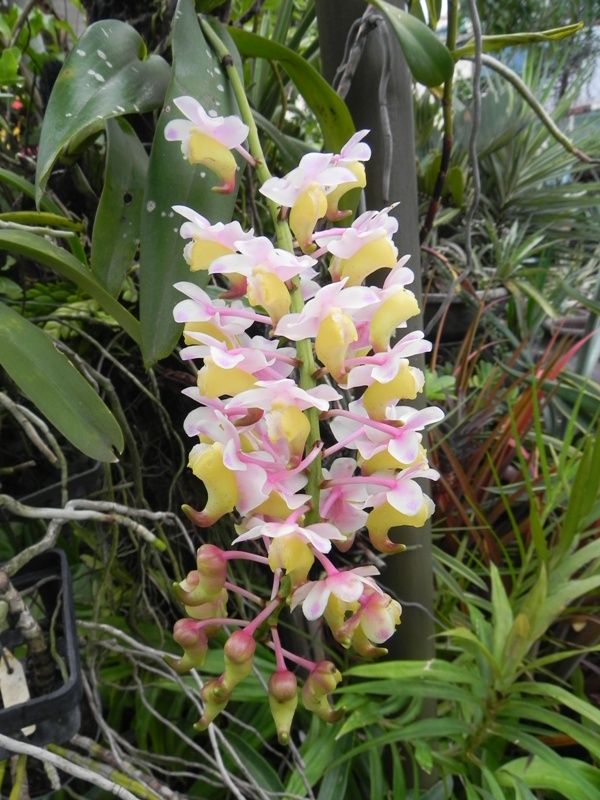
My Baby Pink and Yellow Bloomer

Quick Post: I bought this orchid a few weeks ago in the Sunday market. It was labelled Aerides aff. odorata as the seller was not sure if it is odorata. But they were certain it was propagated from plants collected in Palawan. It had an impending flower spike which I was not sure would push through blooming.

Today as I inspected my plants (which I have not done for a long time) this bloom surprised me with its delicate baby colors. Usually in specimens I buy with with flower spikes, blooming is aborted because of transplant shock. Apparently this plant is so eager to be identified in my collection. I am still not sure what Aerides this is. It seems to have more yellow color than the usual Aerides odorata flowers. It is too light to be an Aerides lawrenciae.

Wednesday, June 15, 2011

Journey to the Cross on Mt. Samat

I have seen and known the Mt. Samat cross ever since I was a kid. We used to make the very long trip (pre NLEX and SCTEX) to Villa Imperial near the PNOC complex when I was about 7 or 8 years old. It would take 4 to 5 hours by road travel, and the last hour and a half would always have a good view of the cross on top of the mountain. I always wondered what is up there. I have heard of stories that the cross is actually a building with an elevator. Also that it is a tomb for some of the soldiers who died in World War 2. I never got to go up and confirm these, till April this year, which is 30 years after.

My sister Cecil and her sons did not have anything to do on a Good Friday so we decided to go on the pilgrimage to climb up Mt. Samat and learn what is really up there. We made the trip via NLEX and the San Fernando - Bataan Road. The trip was shortened to almost just a couple of hours because of the improvement of the road infrastructure, a far cry from trips we made when I was little. Once we reached that intersection after Balanga in Bataan, slowly we made the ascent to the wooded areas on the foot of the marked mountain. The straight roads of the highway was transformed into curving till it was almost zigzagging. Bends became sharper and negotiating the turns went from manageable to hard for our vehicle as the road sloped steeper. But surprisingly there was pedestrian traffic running alongside the vehicles, even when there was no sidewalk on the road. People were doing their own pilgrimages by foot, a much harder task to hurdle as the mountain is surprisingly high and rugged. This is unexpected as it is not apparent that Samat is a slightly tough cookie to conquer, when you see the view of it and its cross at lower elevation.

When we neared the entrance of the cross shrine, we realized our ordeal was far from finished. We had to continue on foot as the parking was already full and the road going up to the foot of the cross was also packed with parallel parked cars. My heart pounded as I saw the series of stairs leading up our cross goal. I was anticipating my own agony. My younger nephews negotiated the steps easily and of course i lagged behind them and my sister. But slowly and surely, i managed to catch my every breath. With a little help of will power I soon was pacing my last strides, raising my now much heavier calves to the last risers. My ultimte joy was seeing a store selling cold Coca Cola on top of the last flight. Probably the best can of soda I had.

It is true that there is an elevator within the cross, but on that Good Friday afternoon, getting on it was a much greater task than climbing to the cross grounds. There are literally hundreds of people awaiting their turns to get on the elevator car and ascend to the top of the cross, where I heard the view is priceless. We had to content ourselves with the satisfaction of reaching and seeing the cross upclose. Besides, the view at foot level was also something to look forward to. Here you could already see the whole of Bataan and Manila Bay. We were already very much happy with what we saw and experienced.
Probably another surprise was to see that what was on top in the Mt. Samat shrine is not only a monumental cross. It is a complex with a main shrine building, a congregation area with grandstand, accommodation facilities and service areas. The architecture was definitely American influenced, probably Art deco because of the elongated geometric patterns. Minus the very rowdy crowds, I could imagine that the place is indeed a conducive place to remember and contemplate the heros and martyrs of World War 2. It is a monumental island on top of a very green background that is Mt. Samat. Incidentally, the third surprise was to find this part still covered with trees and lush greenery. But regret is that among the thick green of reforested area, exotic trees are very visibly intertwined with the native species. This silent war between natives and exotic flora would not probably merit any monuments like that of the Mt. Samat cross. Just hope that in the end, it is our environment that turns out the big winner.
Eventually my sister, nephews and I found ourselves on the way back feeling like winners ourselves. We have conquered our goal for that day. We reached our cross! It is not a tomb, but a fitting memorial to remind us of a sad part of our Filipino history. I confirmed my suspicions on what was up there on that far cross. And after years and years of wait, I finally reached the summit of Mt Samat.

Sunday, June 12, 2011

Freedom?

Today is Philippine Independence Day. Every June 12 I get reminded with the line from the song 'Bayan Ko'.

'Ibon man may layang lumipad, Kulungin mo at umiiyak'.

People are fortunate they have voice and reasoning. These birds do not. 


Saturday, June 11, 2011

The Biggest Dao!

Ron sizing up the dao
Have you ever seen a dao this big? I have seen young dao trees and much older ones in Daranak falls, UPLB and in Sorsogon. But to date the one standing in Biak na Bato National Park is the biggest I have seen so far.  I can't even get a picture of the whole tree. It has a very large buttress base appearing like a massive wall. It definitely dwarfed all of my companions who tried to get close to it.

Dao is Dracontomelon dao which is a forest tree that forms huge buttress roots to support its humongous size and thick canopy. It is a member of the family Anacardiaceae, which makes it related to the cashew and mango. I hope this tree will live on for many more years and many-many more generations to come.
Sir George at the base of the magnificent dao

Friday, June 10, 2011

A Different Attraction in Parks and Wildlife


The most elaborate costume
The Bulwagang Ninoy 
I was in Ninoy Aquino Parks and Wildlife last Saturday. But aside from the usual plant lecture and visiting the demo plot, we got to experience a different treat - cosplay. Everytime we are at the park we see a lot of younger people dressing up and having their pictures taken. But we always assumed that these were either students making school projects or commercial ads with little location budget.

School girl and warrior
School girls all
Last week I learned that some are basically avid costume addicts dressing up like their favorite cartoon hero (nowadays these are mostly characters in what they call anime or Japanese animation). Just to fully copy the get-up of their favorite anime character is fulfillment enough and the pictures are taken as proof of their accomplishment. And when they are fully-garbed, they are in synch with the character they emulate, complete with weapons and the attitude to make it perfect for the camera. Ultimately they chose the ruggedness of the Wildlife landscape to be their backdrop, a change from the usual concrete jungle setting in Manila. It is really a contrast between action/adventure and serene/natural. To these new breed of cosplayers, more plants versus your zombies and monsters! More power to your hopefully far-from-final fantasies.